👋 关于讲师与个人信息

Jack Bird

欢迎交流学习与教学

英语家教讲师 · 技术与学习方法记录者 · 极简数字书斋主理人

“在喧嚣的数字深渊中,我们寻找的不仅是信息,而是那些能让心灵沉静的锚点。写作与整理,便是把零散知识雕刻成体系的斧凿。”

你好,我是 Jack Bird,一个喜欢写作、记录和分享的长期主义者。平时常读技术与哲学相关内容,习惯将学过的知识与做过的项目沉淀为结构化、可长期复用的认知框架。

搭建这座初三英语学习站的初衷,也是希望能跳出“碎片化刷题”的焦虑——把初中语法拆解成一张清晰的全局蓝图,用听得懂的底层逻辑配合视听讲解与错题自测,陪你把每一次练习都变成扎实的进步。

体系化蓝图

用全局视角串起词法、时态语态与三大从句,告别孤立死记。

讲透底层逻辑

不仅记结论,更讲清规则背后的原因,举一反三少踩坑。

方法与阶段复盘

注重错题归因与笔记体系构建,让提分路径清晰可见。

🎧 视听精讲课堂

视频精讲 · 07:30

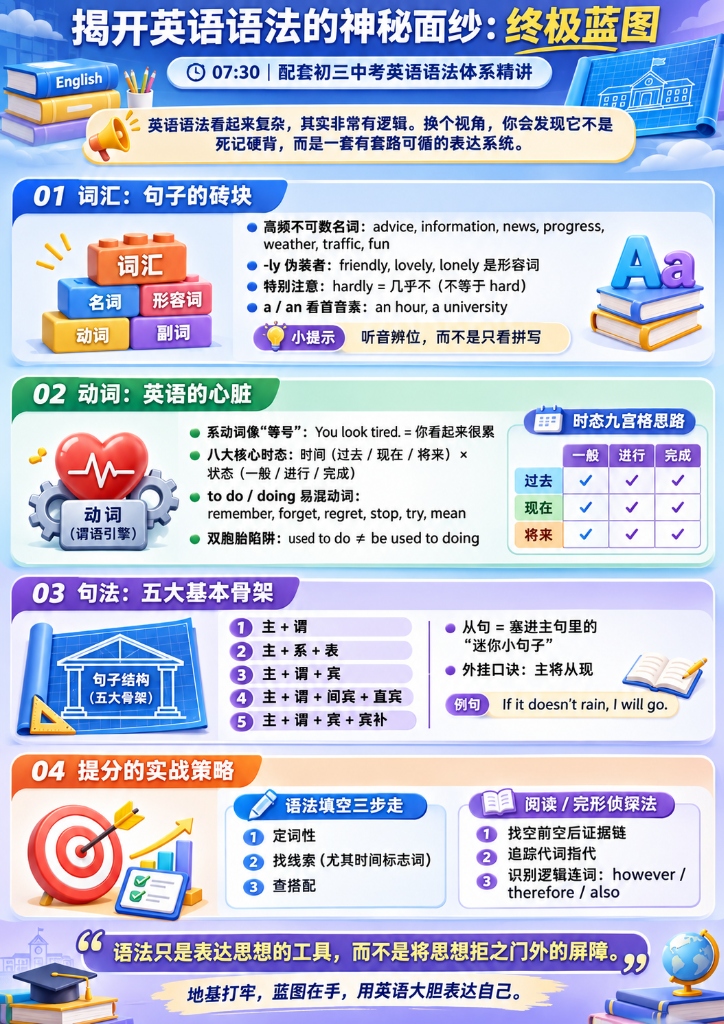
揭开英语语法的神秘面纱:终极蓝图

适合先用 7 分钟建立初中英语语法全局框架,理清词法、时态语态和三大从句。

前往 B站观看原视频 ↗
图文伴学 · 18:13

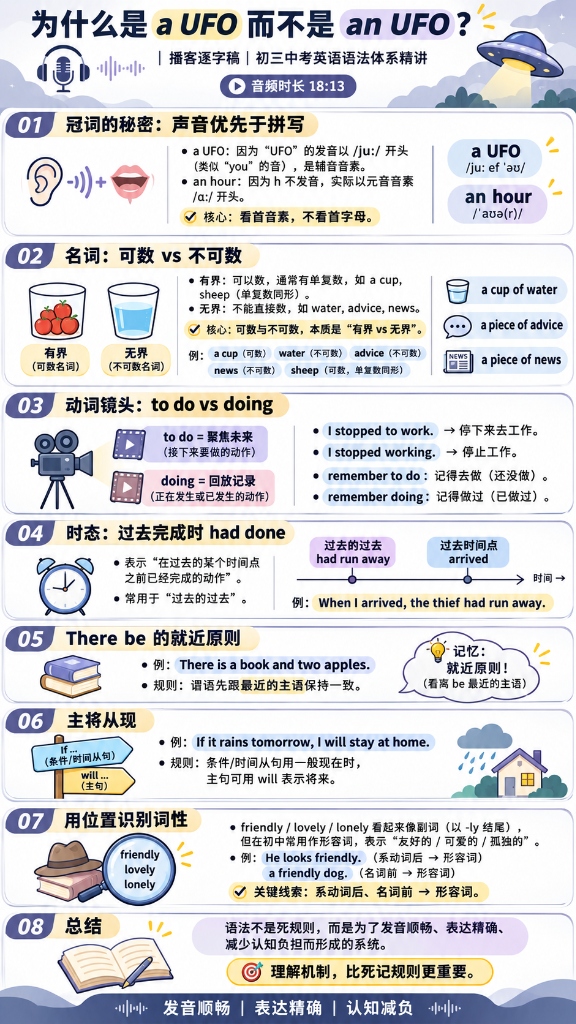
为什么是 a UFO 而不是 an UFO

聚焦冠词首音素、常见词形与底层逻辑,配套 9 页图文 PPT 边听边学。

前往 B站观看原视频 ↗

📌 一图速览(精华知识海报)

《揭开英语语法的神秘面纱:终极蓝图》速览

揭开英语语法的神秘面纱:终极蓝图知识长图

《为什么是 a UFO 而不是 an UFO?》速览

为什么是 a UFO 而不是 an UFO 知识长图

📖 中考英语完整语法体系大全(可搜索直读)

一、词法体系(7 大词类)

1. 名词(Nouns)

(1)可数名词复数变化

  • 规则变化:
  • 一般加 -s(books);
  • 以 s, x, sh, ch 结尾加 -es(buses, boxes, brushes, watches;注意 stomach → stomachs);
  • 辅音字母 + y 结尾,变 y 为 i 加 -es(cities, stories;元音 + y 直接加 -s,如 boys, days);
  • 以 f / fe 结尾,多数变 f/fe 为 v 加 -es(leaf → leaves, knife → knives, life → lives, thief → thieves, shelf → shelves;例外:roof → roofs, belief → beliefs);
  • 以 o 结尾:有生命常加 -es(tomatoes, potatoes, heroes),无生命或缩写词加 -s(photos, pianos, radios, zoos, kilos)。
  • 不规则变化(必背):
  • man → men, woman → women, child → children, foot → feet, tooth → teeth, mouse → mice
  • 单复数同形:sheep, deer, Chinese, Japanese, fish(表鱼肉不可数;表条数单复同形;表种类 fishes)
  • 合成名词:主体名词变复数(apple trees, women teachers, men doctors——注意 man/woman 修饰名词时前后都要变)

(2)不可数名词(谓语一律用单数,不能直接加 a/an 或 -s)

  • 中考高频不可数名词:
  • advice(建议)、information(信息)、news(消息,注意自带 s 但为不可数)、progress(进步)、knowledge(知识)、homework(作业)、work(工作)、weather(天气)、traffic(交通)、fun(乐趣)、furniture(家具)、music(音乐)、beauty(美,作“美人/美好的事物”时可数)。
  • 量化表达:a piece of advice/news/paper/information、two glasses of water、a bowl of rice。

(3)名词所有格

  • 有生命:单数加 's(Tom's);以 s 结尾的复数加 '(teachers' office);不规则复数加 's(Children's Day)。
  • 共同所有 vs 各自所有:
  • Lucy and Lily's room(两人共用一间,单数)
  • Lucy's and Lily's rooms(两人各自的房间,复数)
  • 无生命:用 of(the door of the classroom);时间/距离/国家/城市可用 's(today's newspaper, ten minutes' walk)。
  • 双重所有格:a friend of my father's(我爸爸众多朋友中的一个)。

2. 冠词(Articles)

类型核心规则中考高频陷阱与例词
不定冠词 a / an看单词首音素,不看首字母拼写用 an:an hour, an honest boy, an umbrella, an uncle, an 8-year-old boy;字母/缩写:an MP3, an X-ray, an "f"/"h"/"m"/"s"
用 a:a university, a useful book, a European country, a one-way street, a UFO
定冠词 the特指、上文提过、双方共知、独一无二① 序数词与最高级前(the first, the coolest)
② 西洋乐器前(play the piano,球类棋类不加:play basketball)
③ the + 姓氏复数 表一家人(the Greens 格林一家,谓语用复数)
④ the + 形容词 表一类人(the old, the poor,谓语用复数)
⑤ 江河湖海、山脉、群岛及部分国家全称前(the Great Wall, the US)
零冠词三餐、球类、棋类、学科、语言、星期月份季节(泛指)有无 the 意义不同:in hospital(住院) vs in the hospital(在医院里);at table(吃饭) vs at the table(在桌旁);go to school(上学) vs go to the school(去那所学校)

3. 代词(Pronouns)

(1)人称、物主与反身代词

  • 人称并列顺序:
  • 单数并列:二、三、一(you, he/she and I);复数并列:一、二、三(we, you and they)。
  • 例外:承认错误/承担责任时把 I 放最前。
  • 形容词性物主代词 vs 名词性物主代词:
  • 形物代 + 名词 = 名物代(my book = mine)。
  • 反身代词高频搭配:enjoy oneself(玩得开心)、teach oneself(自学)、by oneself(独自)、help oneself to...(随便吃……)、hurt oneself(伤到自己)。

(2)不定代词(中考高频考点)

范围全肯定任一全否定
两者both(+ 复数动词)either(+ 单数动词)neither(单独作主语常配单数;neither... nor... 就近)
三者及以上allanynone(可指人或物,回答 How many/much 用 none;回答 Who/What 用 no one / nothing)
  • 数量对比:
  • 修饰可数复数:few(几乎没有,表否定) / a few(有几个,表肯定) / many
  • 修饰不可数:little(几乎没有,表否定) / a little(有一点,表肯定) / much
  • other 系列辨析:
  • the other(两者中的另一个:one..., the other...)
  • another(三者及以上中的“另一个/再一”)
  • others(泛指“其他的人或物”,= other + 复数名词)
  • the others(特指剩余的“全部其他人或物”)
  • 复合不定代词(something, anything, nothing, everything, someone...):
  • 作主语时谓语用单数;
  • 形容词修饰复合不定代词必须后置(something important, nothing wrong)。

(3)it 的核心句型

  • 形式主语:It is + adj. + (for/of sb.) + to do sth.(形容词描述事物特性用 for,如 important/easy;描述人的品质用 of,如 kind/polite/clever)。
  • 形式宾语:find / think / make / feel + it + adj./n. + to do sth.。
  • 替代同类不同物 vs one / that:
  • it:同名同物;one:同名异物(可数单数,复数用 ones);that:比较句中替代前文单数或不可数名词(如 The weather here is warmer than that in Beijing.,复数用 those)。

4. 数词(Numerals)

  • 基数词变序数词口诀:
  • 一二三特殊记(first, second, third);八去 t(eighth)、九去 e(ninth)、ve 要用 f 替(fifth, twelfth);整十变 y 为 ie(twentieth);若是几十几,只变个位(twenty-first)。
  • 确数 vs 概数:
  • 具体数字:two hundred students(不加 s 不加 of)
  • 模糊数量:hundreds of / thousands of / millions of students(加 s 加 of)
  • 分数表达:分子基数词,分母序数词;分子 > 1 时分母加 s(one third, two thirds)。作主语时,谓语单复数由 of 后的名词决定。
  • 年龄/世纪:in his thirties(在他三十多岁时);in the 1990s(20 世纪 90 年代)。

5. 介词(Prepositions)

  • 时间介词:
  • at + 具体时刻/正午/午夜(at 7:00, at noon, at night)
  • on + 具体某天/星期/日期/具体某天的早中晚(on Sunday, on May 1st, on a cold morning)
  • in + 年/月/季节/世纪/泛指早中晚(in 2019, in winter, in the morning);in + 时间段 表“……之后”(常配将来时,用 How soon 提问)
  • for + 时间段 / since + 过去时间点(常配现在完成时,用 How long 提问)
  • 方位与穿越介词:
  • in(内部)、on(接壤)、to(隔开不接壤)
  • across(表面穿过,如过马路) vs through(内部穿过,如穿过森林/花园 walk through the garden) vs over(上方越过)
  • between(两者之间) vs among(三者及以上之间)
  • 方式介词:
  • by + 交通工具(无冠词 by bus) / by doing(通过做某事)
  • with + 具体工具/材料(write with a pen)
  • in + 语言/颜色/衣着(in English, in red)

6. 形容词与副词(Adjectives & Adverbs)

  • 核心句法分工:
  • 形容词:作定语(修饰名词,复合不定代词后置)、表语(系动词后)、宾补(keep/make/find + sb./sth. + adj.)。
  • 副词:修饰实义动词、形容词、其他副词或整句(放句首常加逗号,如 Luckily, ...)。
  • 易错词形陷阱:
  • 以 -ly 结尾但却是形容词的词:friendly, lovely, lonely, lively, daily, weekly。
  • 同形副词与 -ly 副词词义不同:hard(努力地) vs hardly(几乎不);late(晚) vs lately(最近);high(位置高) vs highly(高度地);close(靠近) vs closely(密切地)。
  • 比较级与最高级(形容词和副词都有!):
  • 不规则变化:good/well → better → best;bad/badly/ill → worse → worst;many/much → more → most;little → less → least;far → farther/further → farthest/furthest。
  • 高频句型:
  1. as + 原级 + as / not as(so) + 原级 + as
  2. 比较级 + than(可被 much, even, a little, a lot, far 修饰,不能用 very)
  3. the + 比较级..., the + 比较级...(越……,越……)
  4. 比较级 + and + 比较级(越来越……)
  5. one of the + 最高级 + 复数名词(最……之一)
  6. the + 序数词 + 最高级 + 单数名词(第几最……)

7. 连词(Conjunctions)

  • 并列连词:and(顺承)、but(转折)、or(选择 / “否则”)、so(因果)。
  • 固定句型:祈使句 + and/or + 陈述句(常用 will)(如 Stick to your dream, and you will be successful.)。
  • 对称关联连词:both... and...、either... or...、neither... nor...、not only... but also...。
  • 从属连词:引导各类状语从句及宾语从句(详见第三部分)。

二、动词体系(分类 · 8 大时态 · 被动语态 · 非谓语 · 短语)

1. 动词四大分类与情态动词

  1. 实义动词:分及物动词(vt.,后直接跟宾语,有被动)和不及物动词(vi.,后需加介词才能跟宾语,无被动,如 happen, arrive, appear, die, rise)。
  2. 系动词:be 动词 + 感官动词(look, sound, smell, taste, feel)+ 变化动词(become, get, turn, grow, go)+ 保持动词(keep, stay, remain)。系动词后接形容词作表语,且无被动语态。
  3. 助动词:be, do/does/did, have/has/had, will/would(帮助构成时态、语态、否定、疑问,无实际词义)。
  4. 情态动词(后一律接动词原形):
  • Must I...? → 肯定 Yes, you must.;否定 No, you needn't / don't have to.(mustn't 表“禁止”)。
  • May I...? → 否定 No, you mustn't / can't.。
  • 表推测:肯定推测 must(一定);可能 may / might / could;否定推测 can't(不可能)。

2. 中考 8 大核心时态

时态构成核心用法与高频标志词关键易错点
1. 一般现在时do / does
am / is / are
经常/习惯动作、客观真理、现存状态;标志:always, usually, often, every day/year, today① 三单 -s/-es;② 客观真理在宾从永用一现;③ 时间/条件状从主将从现
2. 一般过去时did
was / were
过去某时间发生的已结束动作;标志:yesterday, ... ago, in 2019, last night, just now区分单纯过去点(如 in 2019)与现在完成时(不要过度脑补对现在的影响)
3. 一般将来时will + do
am/is/are going to + do
将来动作或打算;标志:tomorrow, next week, in + 时间段, in the futurego, come, leave, arrive, start 等位移动词可用现在进行时表将来
4. 过去将来时would + do
was/were going to + do
站在过去看将来;常见于主句为过去时的宾语从句中He said he would come the next day.
5. 现在进行时am/is/are + doing说话时正在进行;标志:now, at the moment, Look!, Listen!感官、心理、拥有类状态动词(know, like, have(拥有), want, be)一般不用进行时
6. 过去进行时was/were + doing过去某时刻或某段正在进行;标志:at that time, at 8 yesterday, while结合 when(点动作常用过去式)与 while(延续动作常用进行时)区分
7. 现在完成时have/has + done过去开始持续至今,或对现在造成影响;标志:already, yet, ever, never, just, so far, until now, over the (past) years, since + 过去点, for + 时间段延续性动词转换(配 for/since/how long 时):
buy → have, borrow → keep, die → be dead, leave → be away, join → be in / be a member of, begin/start → be on, finish/end → be over, open → be open, close → be closed, marry → be married
区分 have been to(去过已回)、have gone to(去了未回)、have been in(待在某地)
8. 过去完成时had + done“过去的过去”;标志:by the end of last..., by the time + 过去式, before + 过去点必须有明确的“过去参照点”,才会用到过去的过去

3. 被动语态(be + done)

  • 各时态被动公式:
  • 一般现在时:am / is / are + done(Chinese gardens are admired by visitors.)
  • 一般过去时:was / were + done(The old library was built in 2019.)
  • 一般将来时:will be + done / am/is/are going to be + done
  • 情态动词:can / must / should + be + done
  • 现在完成时:have / has + been + done
  • 中考 3 大特殊规则:
  1. 无被动动词:不及物动词(happen, take place, break out, come out, disappear)、系动词(look, taste, smell, feel)、belong to(属于)。
  2. 主动形式表被动意义:The book sells well. / The pen writes smoothly. / The coat washes easily. / need/require/want + doing(如 The bike needs repairing = needs to be repaired)。
  3. 还原 to:主动省 to 的使役/感官动词(make/let/see/hear sb. do)变为被动时,必须把 to 补回来(be made to do, be seen to do)。

4. 非谓语动词(不作谓语的动词形式)

形式核心功能高频搭配与考点
不定式 to do表目的、将来、具体某次动作① 作目的状语(use ... to mix);
② 常接 to do 作宾语/宾补:decide / try / want / hope / plan / wish / refuse / afford + to do;tell / ask / encourage / allow / advise sb. + to do;
③ 省 to 情况:使役动词 let / make / have sb. do;感官动词 see / watch / hear / notice sb. do;had better (not) do;Why not do?
动名词 doing相当于名词,作主语/宾语① 作主语时谓语用单数(Reading English is helpful.);
② 只接 doing 的高频词/短语:enjoy, finish, practice, mind, suggest, avoid, keep, consider, imagine, be worth, give up, put off, can't help, look forward to, pay attention to, be/get used to
分词 doing / done作定语/表语/宾补① doing 表主动/正在进行;done 表被动/完成(a garden named Ming Xuan);
② see sb. doing(看见某人正在做) vs see sb. do(看见全过程);
③ have/get sth. done(让某事被做,如 have my hair cut)
  • 必背“接 to do 与 doing 词义不同”的 6 个动词:
  • remember / forget / regret + to do(未做) vs + doing(已做)
  • stop to do(停下来去做另一件事) vs stop doing(停止正在做的事)
  • try to do(尽力/试图做) vs try doing(尝试着做)
  • mean to do(打算做) vs mean doing(意味着)

5. 高频动词短语速查(易混组)

  • with 系列:put up with(忍受)、catch up with(赶上)、come up with(想出)、get along/on with(相处融洽)、agree with(同意)、deal with(处理)。
  • up 系列:give up(放弃)、take up(占据/开始从事)、pick up(捡起/接人/学会)、look up(查阅)、set up(建立)、make up one's mind(下定决心)。
  • out / off / on 系列:carry out(执行)、work out(算出/解决)、find out(查明)、put off(推迟)、take off(起飞/脱下)、turn on/off/up/down、stick to(坚持)。

三、句法体系(句型 · 主谓一致 · 3 大复合句 · 特殊句式)

1. 五大基本句型(辨析句子成分的基础)

  1. 主 + 谓(S + V):They are walking.
  2. 主 + 系 + 表(S + V + P):It is easier.(系动词后接形容词/名词)
  3. 主 + 谓 + 宾(S + V + O):He followed the advice.
  4. 主 + 谓 + 间宾 + 直宾(S + V + IO + DO):give sb. sth. = give sth. to sb.(buy/make 用 for)
  5. 主 + 谓 + 宾 + 宾补(S + V + O + OC):keep everything in order / encourage us to read

2. 四大句子功能类型 & There be 句型

  • 特殊疑问句辨析:How long(多久/多长,答 for/since)、How soon(多久以后,答 in + 时间段)、How often(多久一次,频率)、How far(多远,距离)。
  • 反意疑问句(前肯后否,前否后肯):
  • 含否定词 hardly, seldom, never, few, little, nothing, nobody 时,陈述部分视作否定,附加问句用肯定;
  • Let's..., shall we? vs Let us..., will you?;
  • 祈使句一般用 will you?(否定祈使句也用 will you?)。
  • 感叹句:
  • What + (a/an) + 形容词 + 名词 (+ 主语 + 谓语)!(不可数/复数名词前不加 a/an,如 What good news!)
  • How + 形容词/副词 (+ 主语 + 谓语)!(或 How + adj. + a/an + 单数名词 + 主谓!)
  • There be 句型:
  • 遵循就近原则;不能与 have 连用;
  • 将来时:There will be / There is(are) going to be;现在完成时:There have/has been。

3. 主谓一致三大原则

  1. 语法一致:单数/不可数/动名词/不定式作主语 → 单数谓语;复数名词/both...and... → 复数谓语。
  2. 意义一致:
  • family / class / team / group:强调整体用单数,强调成员用复数;
  • people / police / cattle:通常用复数;
  • 时间、金钱、距离、重量作主语表整体 → 单数(Ten years is a long time.);
  • the + 形容词 表一类人(the old / the rich)→ 复数。
  1. 就近原则 vs 就远原则:
  • 就近原则:neither... nor..., either... or..., not only... but also..., there be。
  • 就远原则:主语后接 with / together with / along with / as well as / besides / except + 名词 时,谓语单复数由前面的主语决定(The teacher, with his students, is visiting the museum.)。

4. 三大复合句(中考重难点)

(1)宾语从句(三要素缺一不可)

  1. 引导词:that(陈述句,可省);if / whether(一般疑问句,“是否”;与 or not 连用或作介词宾语时只用 whether);特殊疑问词(what, who, where, when, why, how)。
  2. 语序:永远用陈述语序(引导词 + 主语 + 谓语)。
  • 例:I wonder where he lives.(❌ where does he live)
  1. 时态呼应:主现从任意;主过从过去(一般过去/过去进行/过去将来/过去完成);客观真理、自然规律永用一般现在时。

(2)状语从句

  • 时间状语从句:when / while / as、before / after、since(主句常用现完,从句常用一般过去)、until / not... until...(主句瞬间动词用 not... until)、as soon as。
  • 主将从现:时间(when, until, as soon as)和条件(if, unless, as long as)状语从句中,主句用将来时/祈使句/含情态动词,从句用一般现在时表将来。
  • 原因状语从句:because(语气最强,回答 why)、since(既然)、as(由于)。because 不能与 so 连用。
  • 结果与目的状语从句:
  • so + adj./adv. + that... vs such + (a/an) + adj. + n. + that...(注:many/much/few/little(少) 前必须用 so,如 so many books)。
  • so that / in order that(为了,常配 can/could/may)。
  • 让步状语从句:although / though / even if / even though。although/though 不能与 but 连用(但可与 still/yet 连用)。

(3)定语从句(关系词选择)

  • 关系代词(在从句中作主语、宾语或定语):
  • 指人:who(主/宾)、whom(宾)、that(主/宾)、whose(定语,“……的”)。
  • 指物:which(主/宾)、that(主/宾)、whose(定语)。
  • 注:作宾语时可省略;介词后只能用 which(指物)或 whom(指人),不能用 that。
  • 关系副词(在从句中作状语):when(时间,= 介词 + which)、where(地点,= 介词 + which)、why(原因,= for which)。
  • 只用 that 不用 which 的高频情况:
  1. 先行词是不定代词 all, everything, anything, nothing, much, little, none;
  2. 先行词被 the only, the very, all, every, no 或最高级 / 序数词修饰;
  3. 先行词既有人又有物。
  • 祈使句:Do... / Don't... / Never... / Let's... / No + doing(n.)(如 No smoking!, No photos!)。
  • 疑问词 + 不定式:what to do / how to do it / where to go(可在句中作宾语、主语或表语,注意 what 作 do 的宾语,how 作状语所以后面常需补 it)。
  • 四大“花费”辨析(中考必考):
  • sb. spend + 时间/金钱 + (in) doing sth. / on sth.
  • It takes (sb.) + 时间 + to do sth.
  • sth. cost (sb.) + 金钱(cost 过去式/过去分词同形)
  • sb. pay + 金钱 + for sth.
  • “提供”与“组成/制造”:
  • provide sb. with sth. = provide sth. for sb.;offer sb. sth. = offer sth. to sb.;offer to do sth.
  • be made of(看得出原材料,如桌子由木头做) vs be made from(看不出原材料,如纸由木头做) vs be made in(某地制造) vs be made into(被制成……)
  • used to 三兄弟与偏好句型:
  • used to do sth.(过去常常) vs be/get used to doing sth.(习惯于) vs be used to do sth.(被用来做)
  • prefer doing A to doing B(to 为介词)= prefer to do A rather than do B = would rather do A than do B
  • 结果与能力转换:too + adj./adv. + to do(太……而不能)= so + adj./adv. + that... can't... = not + 反义 adj./adv. + enough to do(如 too young to go = not old enough to go)。

四、构词法(中考词形变化核心)

1. 派生法(前缀改词义,后缀改词性)

  • 常见否定/功能前缀:
  • 否定:un-(unhappy, unusual, unable)、im-(impolite, impossible, impatient)、in-(incorrect, inexpensive)、dis-(disagree, dishonest, disappear)、mis-(misunderstand, mistake)
  • 其它:re-(再/重:rewrite, reuse, recycle)
  • 常见词性后缀:
  • 名词后缀:-er/-or(teacher, visitor, inventor)、-ist(artist, scientist)、-tion/-sion(invention, decision, discussion)、-ment(development, achievement)、-ness(happiness, kindness)、-ity(ability, activity)
  • 形容词后缀:-ful(helpful, careful)、-less(careless, helpless, useless)、-able(comfortable, valuable)、-ous(famous, dangerous)、-y(rainy, healthy, lucky)、-al(traditional, natural, personal)、-ly(friendly, lovely, lonely)
  • 副词后缀:-ly(carefully, easily, certainly, truly——注意 true → truly, terrible → terribly, happy → happily)

2. 合成法与转化法

  • 合成词:weekend, blackboard, sightseeing;合成形容词中间加连字符且名词用单数(如 a 15-year-old boy, a Chinese-style garden)。
  • 转化法(一词多性):water(n.水 / v.浇水)、clean(adj.干净的 / v.打扫)、empty(adj.空的 / v.倒空)、present(n.礼物 / adj.出席的 / v.呈现)。

五、特殊句式与高频辨析补充

1. 倒装句(So / Neither 句型)

  • So + 助/be/情 + 主语:表示“……也一样”(前后主语不同)。
  • —He likes reading. —So do I.
  • Neither / Nor + 助/be/情 + 主语:表示“……也不”(前后主语不同)。
  • —He didn't go. —Neither did I.
  • So + 主语 + 助/be/情:表示“的确如此”(前后指同一人/事,不倒装)。
  • —He works hard. —So he does.

2. 间接引语与初中基础虚拟语气

  • 间接引语(转述他人话语):遵循宾语从句“陈述语序 + 时态后退”规则;祈使句转述用 tell / ask / order sb. (not) to do sth.;时间/地点/指示代词常随语境转换(now → then, today → that day, here → there, this → that, come → go)。
  • 基础虚拟语气(中考拓展):If I were you, I would + 动词原形...(与现在事实相反,用 were 和 would)。

六、中考高频题型实战解题通法

  1. 语法填空 / 综合填空:
  • 有提示词:先定词性(动词 → 三步定型法 / 非谓语;名词 → 单复数/所有格;形/副 → 比较级/最高级/词性互转;代词 → 主宾格/物主/反身)。
  • 无提示词:先用“谓语唯一原则”排除连词与非连词,再在冠词(a/an/the)、介词、连词、代词中选。
  1. 完形填空:
  • 精读首段首句定基调;每空强制寻找空前—空后证据链(逻辑转折、复现词、固定搭配),不凭局部直觉猜词。
  1. 阅读与信息还原:
  • 阅读题:题干定位原文原句,对比选项,警惕“原文提过但非主旨 / 偷换范围”干扰项。
  • 信息还原:盯住空格前后的代词指代(it/they/this/such)+ 逻辑连词(however/therefore/also)+ 复现词。

✍️ 课堂高频易错题即时自测

1. Chinese gardens ______ (admire) by visitors every year.
解析:主语 Chinese gardens 为复数;by visitors 提示被动语态;every year 表示一般现在时 → are admired。
2. The old library ______ (build) in 2019.
解析:in 2019 是明确的过去时间点,用一般过去时;图书馆被建造用被动 → was built。
3. While the tourists ______ (walk) through the village, it began to snow.
解析:while 引导延续性动作且主句 began 为过去时,用过去进行时;主语 the tourists 是复数 → were walking。
4. It is ______ (easy) to explain a rule than to use it correctly.
解析:is 是系动词,后面需用形容词作表语(不能用副词 easily);结合 than 用比较级 → easier。
5. Why is it ______ UFO instead of ______ UFO?(选出依次填入的两个冠词)
解析:a / an 看单词首音素。UFO 读作 /ˌjuː ef ˈəʊ/,以辅音音素 /j/ 开头,所以用 a UFO(不是 an UFO)。
6. We cannot ______ rude behavior in our classroom.
解析:put up with 意为“忍受”;catch up with 赶上;come up with 想出;get along with 相处融洽。